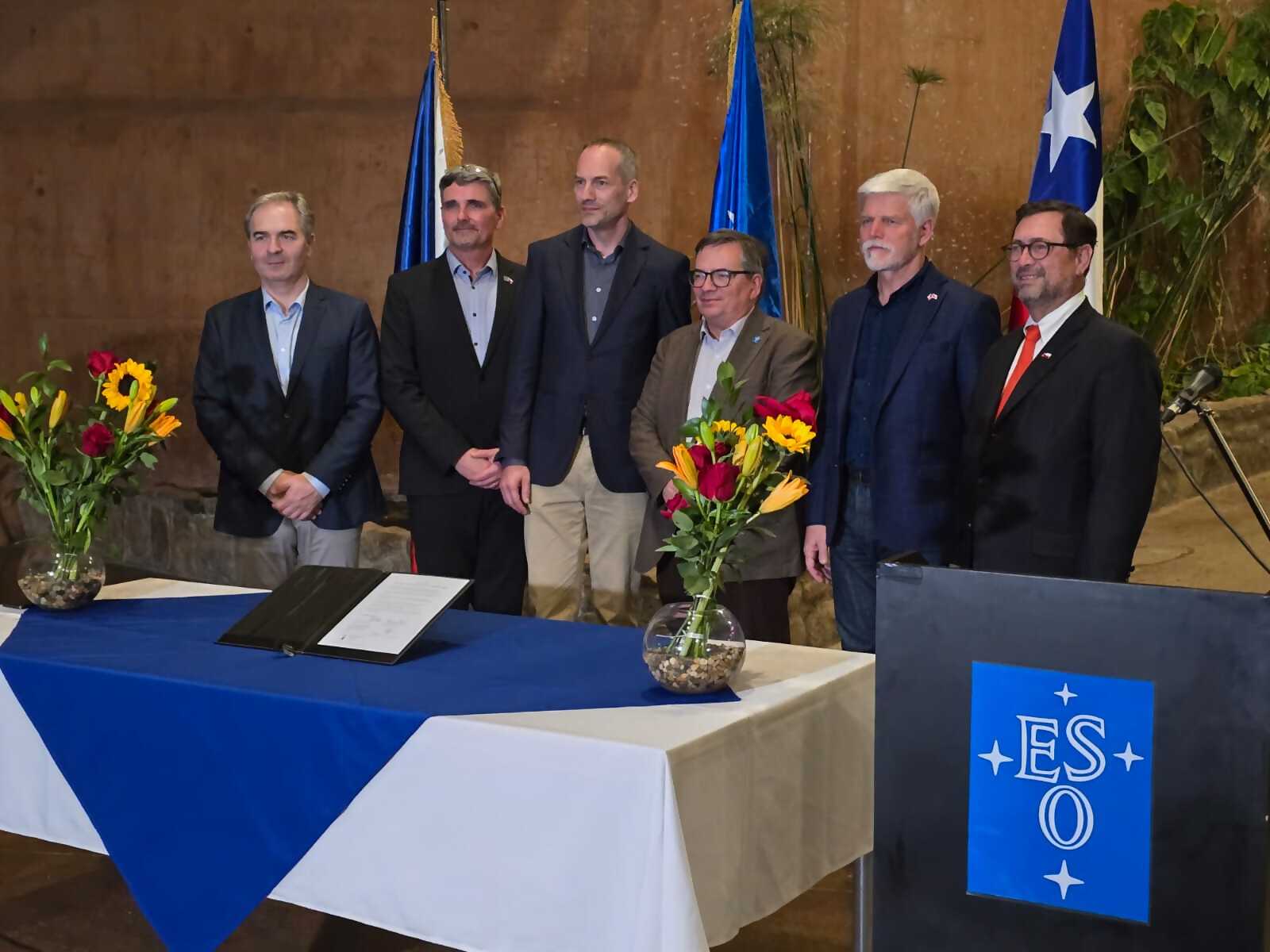
President Petr Pavel visited the ESO observatories in Chile
As part of his official visit to South America, on April 17 of this year Czech President Petr Pavel, accompanied by a delegation of business leaders and scientists and the Chilean Minister of Foreign Affairs, visited the Paranal Observatory in Chile. The observatory is operated by the international organisation ESO (European Southern Observatory), of which the Czech Republic has been a member since 2008.
The delegation was welcomed by ESO Director General Prof. Xavier Barcons. In addition to the world’s most advanced astronomical telescope, the VLT, and its control center, the president also toured the construction site of the ELT (Extremely Large Telescope) on nearby Cerro Armazones. Once completed and put into operation (planned for 2029–2030) it will become the largest and most advanced astronomical facility in the world.
The Czech Republic’s membership in ESO is administered by the Ministry of Education, Youth and Sports (MŠMT). Czech scientists actively use the Paranal Observatory and its facilities for observations and analyses. The La Silla Observatory, also managed by ESO, is home to the Czech PlatoSpec project—a telescope and spectrograph that was renovated and installed for observation by the Institute of Astronomy of the Czech Academy of Sciences in collaboration with two Chilean universities. With the support of the MŠMT, this institute also plans to participate in the construction of the ANDES spectrograph, which will become an important component of the ELT telescope as one of its instruments. The Czech Republic’s participation in the ANDES consortium will not only create an opportunity for Czech astronomers to use this spectrograph but will also open the door for Czech companies to get involved.
ESO Director General Prof. Barcons said during his visit: “We are very pleased to welcome President Pavel and his delegation to Paranal. The Czech Republic has been a highly committed and supportive ESO member state for nearly 20 years.” He also highlighted the successful collaboration between the Ministry of Education, Youth and Sports and ESO, which led to the establishment of an internship program in engineering and science for young Czech astronomers and engineers: “This program now serves as a model for other member states.” Prof. Barcons also mentioned the upcoming involvement of the Astronomical Institute in the ANDES project: “The involvement of Czech institutes in the development of instrumentation for the ELT are examples of how cooperation between ESO and the Czech Republic is advancing astronomy and, at the same time, how the Czech Republic is investing in a new generation of scientists and engineers.”